
Do You Really Need a Bale Wrapper for Mini Round Bales?
As mini round balers grow in popularity among small acreage owners and livestock producers, questions about bale protection naturally follow. One of the most common is whether mini round bales need to be plastic wrapped to protect them from the elements.
The short answer: a bale wrapper is a specialized tool designed for haylage/silage production, not general weather protection. For most mini round bale operations focused on dry hay, plastic wrapping is unnecessary and can actually increase the risk of spoilage.
What Bale Wrappers Are Designed For
Bale wrappers exist to support haylage/silage systems, not dry hay storage.
Haylage and silage are forages baled at higher moisture and sealed in plastic to create an airtight, anaerobic environment that allows fermentation to preserve the feed. In this process, the wrap is not just blocking rain—it enables a biological preservation method.
If fermentation does not occur correctly, the plastic offers no real benefit and can trap moisture, leading to spoilage.
When Producers Choose Haylage/Silage
Haylage/silage can be the right solution in specific situations, such as:
- In areas where unpredictable weather makes drying hay difficult – typically the upper midwest and northeast regions of the United States
- There is need to preserve forage quality during tight harvest windows
- In feeding programs designed for fermented forage – most commonly in the dairy industry
In these cases, plastic wrapping is essential because it is part of the preservation process—not a form of simple weatherproofing.
Dry Hay vs. Haylage/Silage: Different Systems
Dry hay and haylage/silage rely on completely different preservation methods:
- Dry hay is preserved through proper curing – which is reliant on drying and airflow
- Haylage/silage is preserved through controlled fermentation
Wrapping dry hay in plastic does not turn it into haylage/silage. Instead, it can trap residual moisture, increasing the risk of mold, nutrient loss, and forage rejection by livestock. It can even increase the risk of barn fires.
For most mini round bale producers in the U.S., the goal remains high-quality dry hay, not fermented feed.
When Plastic Wrapping Mini Round Bales Makes Sense
Plastic wrapping is appropriate only when all of the following are true:
- You are intentionally producing haylage/silage
- Moisture levels are tightly controlled at baling
- Bales are wrapped immediately after forming
- You have a feeding system designed for fermented forage
This setup remains uncommon among mini round baler owners, who typically produce dry hay for horses, small livestock, or personal use.
The Practical Challenge of Plastic Wrapping Mini Bales
Mini round bales change the efficiency equation.
Instead of handling a few large bales, producers manage many smaller ones. If plastic wrap is used, each bale must be wrapped individually, which leads to:
- Immensely increased labor and handling time
- Higher plastic film costs
- Slower harvest and storage workflows
Over a season, these added steps and materials can significantly raise operating costs.
Hidden Risk: Discovering Problems at Feeding Time
With plastic-wrapped bales, spoilage often remains hidden until the bale is opened.
If preservation fails, producers may find:
- Mold growth inside the bale
- Sour or rotten odors
- Reduced nutritional value
- Feed livestock refuse to eat
- Entire bales that must be discarded
When working with many small bales, one moisture or timing mistake can impact a large portion of the season’s feed supply.
Net Wrap and Twine: Proven Solutions for Dry Mini Round Hay
For dry hay, protection starts with proper baling and smart storage—not plastic film.
Net Wrap
- Maintains tight, consistent bale shape
- Sheds rainfall effectively
- Performs well for outdoor storage
Twine
- Cost-effective and widely used
- Creates breathable, stable bales
- Maintains forage quality when stored under cover
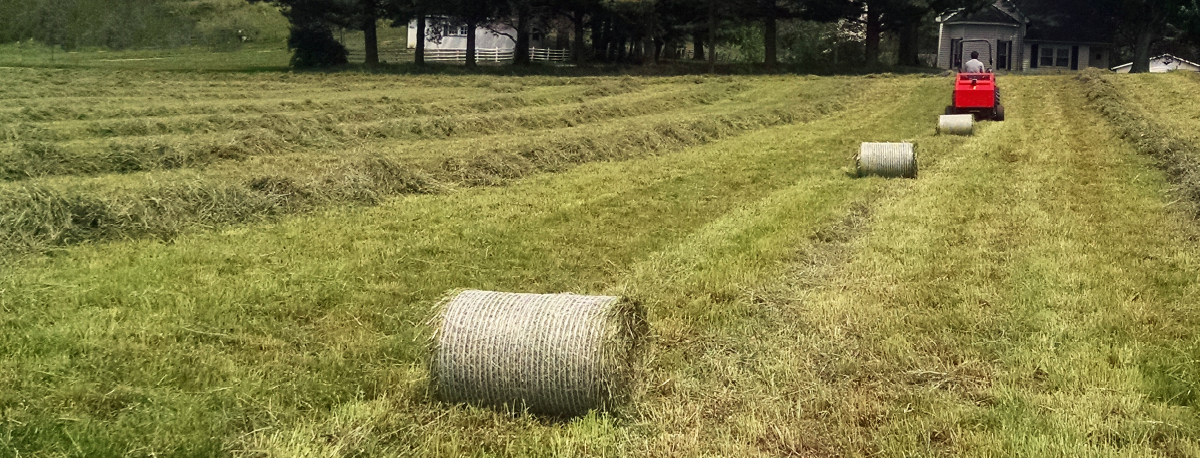
Twine-wrapped mini round bales stored in a barn, under a roof, or with proper ground separation and covering can maintain excellent feed quality without added complexity. For even more information on storage check out our past blog, Tips for Storing Hay.
Matching Equipment to Real Needs
In hay production, more equipment does not always mean better results, and a bale wrapper is almost always a superfluous addition.
The most successful systems are built around:
- Understanding forage and moisture management
- Matching tools to the chosen preservation method
- Avoiding equipment that solves problems you don’t actually have
For standard dry mini round hay, net wrap and twine remain proven, economical, and reliable solutions when paired with proper storage practices. Frankly, bale wrappers are a waste of valuable time and money for almost all small-farm operations.
Looking for mini round balers, net wrap, or twine systems designed for small farms and compact tractors? Explore our selection of hay equipment built to match real-world operations and practical forage goals. Then give us a call at 260-BALE-HAY today, and one of our knowledgeable team members will set you up with the equipment that meets your specific small farm’s needs.
Recent Posts
-

Do You Really Need a Bale Wrapper for Mini Round Bales?
As mini round balers grow in popularity among small acreage owners and livestock producers, ques …Apr 1st 2026 -

Small-Farm Balers: Mini Round Twine vs. Mini Round Net vs. Compact Square
Which Baler is Right for Your Compact Tractor and Small-Farm Operation? Small farms and owners …Mar 18th 2026 -

How to Choose the Right Kubota BX Tractor for Your Small Farm or Property
Kubota BX tractors are among the most popular sub-compact tractors on the market—and for good re …Feb 23rd 2026