
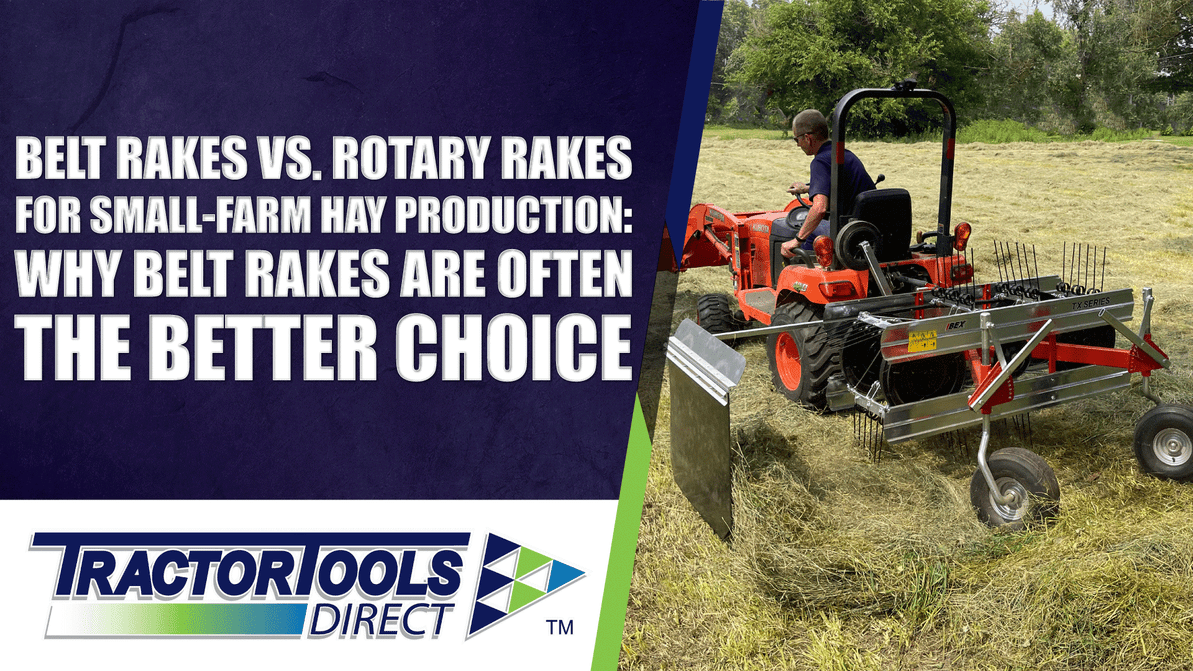
Belt Rakes vs. Rotary Rakes for Small-Farm Hay Production: Why Belt Rakes Are Often the Better Choice
If you’re a small-acreage farmer diving into hay production — or dreaming of haying independence — choosing the right hay rake can make the difference between a smooth operation and a season of frustration. Two popular hay rake styles you’ll encounter are belt rakes and rotary rakes. This blog breaks down how they compare and why, for many small farms, a belt rake delivers extra advantages in ease of use, simplicity, and maintenance.
Understanding the Basics: What Do Hay Rakes Do?
Regardless of type, hay rakes have one essential job: to gather cut hay into windrows so your baler can pick it up cleanly. Proper windrowing helps hay dry faster and more evenly, which boosts bale quality and animal nutrition.
What Is a Rotary Rake?
Rotary rakes use spinning reel arms or tines driven by a mechanical gearbox to lift hay and form a loose, uniform windrow. Their gentle rotary action minimizes leaf loss and handles both wet and dry forage well. Because the tines don’t touch the ground, they help keep debris out of your crop — a quality advantage for feed.
Pros of Rotary Rakes
- Creates consistent, fluffy windrows optimized for drying.
- Good at managing heavier or damp hay crops.
- Works well on uneven ground and contours.
Cons of Rotary Rakes
- More complex mechanical components (like gearboxes and drives) — meaning more maintenance and potential for parts to wear or fail.
- Often larger and heavier, which can be a disadvantage for lightweight tractors or tight fields.
What Is a Belt Rake?
A belt rake — sometimes called a power rake — uses rotating belts with tines mounted perpendicular to travel. As the belts turn, they pick up hay and carry it gently to the side, dropping it behind the tractor as a clean, consistent windrow.
Key Belt Rake Advantages for Small Farms
1. Simplicity & Low Maintenance
One of the biggest benefits of a belt rake is its mechanical simplicity. Unlike many rotary rakes, belt rakes do not use a complex gearbox or multiple internal drives that can fail or need frequent servicing. This means fewer parts to break — especially important if you value ease of use and low maintenance.
2. Compact & Tractor-Friendly
Belt rakes are typically more compact and lightweight, making them easier for small tractors to lift and maneuver — an ideal match for the tight, fenced, and irregular fields common on small farms.
3. Better for Tight Spaces & Corners
Because the belt continues to operate even when the tractor is stopped or backing up, you can use belt rakes in tight spots and around obstacles without leaving messy piles.
4. Dual-Function Raking & Tedding
Many belt rakes, like the Ibex Belt Rake, convert from rake to tedder in seconds by removing a hay stop — no tools required. That versatility means you can flip hay for drying or gather it into windrows with the same tool, reducing the need for extra equipment.
5. Adjustable Windrows
Belt rakes let you fine-tune windrow width to match your baler’s needs — a big plus when maximizing bale efficiency.
What the Experts Say
In Haying Independence: The Ultimate Guide to Small-Farm Hay Production with Your Compact Tractor, author Marti Livengood Goodwin stresses the importance of choosing hay equipment that’s easy to maintain and suited to your tractor — especially for small farms seeking self-sufficiency. That includes matching the right rake to your operation’s size and goals.
Why Belt Rakes Often Win for Small Farms
For many hobby farmers and small acreage operations, the belt rake stands out not because rotary rakes are bad — but because belt rakes offer a simpler, more user-friendly experience with fewer things to break. If you’re just beginning with hay or doing it without a fleet of mechanics nearby, that simplicity translates directly to less downtime, lower repair costs, and more confidence in the field.
Final Thoughts
Choosing between a belt rake and a rotary rake comes down to how much complexity and maintenance you’re prepared to manage. Rotary rakes have their place — especially in larger operations where speed and heavy forage handling matter. But for small-farm hay producers focused on ease of use, reliability, and straightforward maintenance, belt rakes often deliver the best combination of performance and peace of mind.
Ready to Explore Hay Rake Options?
Visit the Tractor Tools Direct hay equipment section to see belt rakes sized for compact tractors and learn how they can elevate your hay production this season. If you would like to talk to a real person with real experience using a belt rake for small-farm hay production call 260-BALE-HAY and speak to one of our knowledgeable team members. Happy Haying!
Recent Posts
-
Drum Mowers vs Disc Mowers: Why Drum Mowers Are Often Better for Small-Farm Haying
When it comes to harvesting hay on a small farm, choosing the right mower can make a big differe …May 21st 2026 -
Beyond the Field: Other Smart Uses for Power Harrows
When most people think of a power harrow, they picture seedbeds, food plots, or pasture renovati …May 15th 2026 -
Belt Rakes vs. Rotary Rakes for Small-Farm Hay Production: Why Belt Rakes Are Often the Better Choice
If you’re a small-acreage farmer diving into hay production — or dreaming of haying independence …May 6th 2026